AI Search Optimization vs SEO: Which Wins in 2026?
By Julian Goldie · 24 Nov 2026
If you have been comparing ai search optimization vs seo, you have probably noticed that most of page one stops at definitions. You get told what AI search is, what SEO is, and then the article ends without answering the question you actually have: where should your next dollar and your next hour go?
That gap matters, because the two disciplines now compete for the same budget while behaving very differently. One can move rankings in weeks; the other can move them in days but with less control over who sees the answer. Choosing wrong costs you either traffic or time, and most businesses cannot afford to lose both.
This comparison puts them head to head on the criteria you care about: cost, time-to-results, traffic quality, lead conversion and ROI. You will get a clear verdict per use case, plus a hybrid workflow you can start this week without doubling your workload.
Key takeaways
- SEO competes for clicks on ranked links; AI search optimization competes to be the source an AI answer is built from, often with no click at all.
- Both channels share the same foundations: topical authority, clean structure, crawl access and trust signals, so one content system can serve both.
- New sites should build SEO fundamentals first; established sites should layer AI search optimization to protect traffic as AI summaries absorb clicks.
- AI search optimization can surface citations in weeks, but sustained visibility still depends on the authority SEO compounds over months.
- The winning play in 2026 is a hybrid: direct-answer content blocks, schema, consistent brand mentions and monthly tracking of both rankings and AI citations.
AI Search Optimization vs SEO: What Each One Actually Is
Traditional SEO in one paragraph
Traditional SEO is the work of making pages rank as links on a search results page. You pick keywords people type, place them in titles, headings and body copy, earn backlinks from other sites, and keep the technical side healthy: fast load times, clean crawl paths, no broken redirects.
The whole discipline assumes a list of blue links and a human deciding which one to click. Semrush data indicates Google processes approximately five trillion searches annually, roughly 13.7 billion per day, ensuring traditional link-based results remain highly relevant.
AI search optimization in one paragraph
AI search optimization, also called AEO, GEO or AI SEO, is the work of getting AI systems to understand, trust and cite your content inside a generated answer. The systems in question are Google's AI Overviews, ChatGPT, Perplexity, Gemini and Copilot.
Optimizely describes AEO as an evolution of SEO rather than a replacement, and points to structured content, schema markup and entity-based optimization as the levers. The practical goal is different: instead of winning a position, you are winning a mention.
Why the two get confused
The core mechanic has shifted. Traditional SEO competes for a click on a ranked link.
AI search optimization competes to be the source an answer is built from, and that answer often resolves the query with no click at all. Industry reports indicate a gradual shift of marketing budgets from traditional SEO toward Generative Engine Optimization (GEO) as AI search usage increases.
The confusion comes from vocabulary overlap. Both disciplines still reward clear structure, genuine authority and topical relevance, which is why so many Reddit and Quora threads conclude "it's the same language." The useful question is not which one replaces the other. It is where your next hour of effort should go.
For a concrete starting point on the second discipline, see AI SEO Strategies for Small Business: 7 Steps That Work in 2026.
Head-to-Head: AI Search Optimization vs SEO on the Criteria That Matter
What you're optimizing for
SEO targets crawlers and ranking algorithms: you shape pages so Google and Bing can crawl, index and rank them against a query. AI search optimization targets language models and answer engines that synthesize multiple sources into one response, so you shape content so a model can extract, trust and repeat it. As Optimizely puts it, AEO is not replacing SEO; it is evolving it, because being number one on Google no longer guarantees you appear in the AI summary above it.
Signals each system rewards
- SEO: keywords, backlinks, internal links, metadata, page performance and Core Web Vitals.
- AI search optimization: entity clarity, factual specificity, citations, structured data and third-party corroboration.
The second list looks softer, but it is measurable. MarketingProfs describes AI search as a digital credit score: models weigh authority and trustworthiness, not just cosmetic on-page polish.
Speed, measurement and risk
| Criterion | SEO | AI search optimization |
|---|---|---|
| Primary goal | Rankings and organic clicks | Being cited and mentioned in answers |
| Time to results | Months, compounding | Can surface faster from fresh, structured pages |
| Measurement | Rankings, impressions, clicks | AI citations, share of AI voice, assisted conversions |
| Main risk of ignoring | Starves your crawl and authority base | Losing visibility as summaries absorb clicks |
Forbes cites up to 25% click reduction as AI summaries take over. Track AI citations alongside rankings; our AI SEO strategies for small business covers how to set both up.
Where AI Search Optimization and SEO Overlap (and Why That's Your Advantage)

The two disciplines split on tactics, but they agree on fundamentals. Fix the fundamentals once and both channels get the benefit.
Shared signal: authority
Both reward genuine topical authority. A cluster of pages that covers a subject in depth, with internal links between them, signals expertise to Google's ranking systems and gives language models more material to draw from when they compose an answer.
Scattered thin pages on twenty unrelated topics do neither. Semrush frames AI SEO as an extension of traditional SEO rather than a replacement, and the authority layer is the clearest reason why.
Shared signal: structure and schema
Clear headings, direct answers near the top of a section, FAQ blocks and schema markup help crawlers parse a page and help models extract a clean, quotable claim. Optimizely's breakdown of SEO versus answer engine optimization puts structured content and semantic markup at the center of AI visibility. The same work improves how Google reads the page.
Shared signal: crawl access
If bots can't fetch and parse your pages, nothing else matters. Check your robots.txt and allow GPTBot, PerplexityBot and Google-Extended unless you have a specific reason to block them. Trust signals work the same way: named authors with credentials, cited sources, consistent brand mentions and a real About and contact page carry weight in both channels.
Why the overlap is your advantage
Because the signals are shared, one well-built content system can rank in Google and get cited in AI answers. That hybrid approach is what AI Profit Insider teaches in its AI SEO strategies guide. You build the asset once and compound returns across both.
Where They Diverge: Tactics That Only Work for One
Overlap gets the headlines. The split is where your budget decisions actually live, because some tactics move one channel and do almost nothing for the other.
SEO-only plays
- Aggressive internal linking to push PageRank toward money pages. AI answers rarely reward link flow between your own URLs.
- Backlink building at scale. Domain authority still decides rankings; AI systems weigh corroboration more than raw link counts.
- Chasing high-volume head terms where you can win position one.
- SERP feature engineering: featured snippets, local packs, image and video carousels. These are Google surfaces, not chatbot outputs.
AI-search-only plays
- Writing extractable, quotable answer blocks a model can lift whole.
- Stating facts with numbers and dates, since specificity is what makes a claim citable.
- Getting mentioned in listicles and comparison posts that models scrape during training and retrieval.
- Entity consistency: the same company description, category and positioning everywhere. As Semrush notes, AI SEO extends traditional SEO rather than replacing it, and this is the part with no classic equivalent.
Content format splits too. SEO tolerates a long narrative intro before the payoff. AI search rewards front-loaded answers, tables, definitions and clean "X vs Y" framing.
How keyword research changes
SEO chases volume and difficulty scores. AI search optimization chases conversational, question-shaped prompts and "best/tool/vs" queries people type into chatbots. If you want a starting workflow, our AI SEO strategies for small business walks through it.
Off-page work diverges most. SEO chases domain authority via links; AI search chases corroboration, being mentioned accurately across Reddit, review sites, YouTube and industry publications.
The Verdict: Which Should You Prioritize?
There is no universal winner. The right priority depends on what you already have and who you sell to. Semrush notes that LLM traffic is projected to pass traditional organic search by 2028, but Google still handles roughly five trillion searches a year, so both channels carry real demand today.
Verdict for new sites
Start with SEO fundamentals: technical health, topical content depth, and a few genuine links. AI engines still lean on the same trust base, so authority built for Google transfers. Skipping straight to AI search optimization without that base rarely works.
Verdict for established sites
If you already rank and get traffic, layer AI search optimization on top. Restructure your top pages into extractable answers, add schema, and chase citations in sources AI systems read. You are amplifying assets that already exist, so the payback is faster.
Verdict for local and service businesses
Prioritize SEO for local intent, location pages, reviews, service-area signals, then add AI search optimization for "best X near me" style chatbot queries. Those prompts convert, and being the cited answer is often the whole sale.
Verdict for content sites and agencies
Run both as one system. AI citations increasingly drive the top of funnel while SEO captures the bottom, so splitting them wastes effort.
If you sell AI tools or run a membership, weight AI search optimization higher: your buyers ask chatbots what to use. A structured setup of agents and templates is exactly what AI Profit Insider's AI SEO strategies for small business walks through.
How to Run Both Without Doubling Your Workload
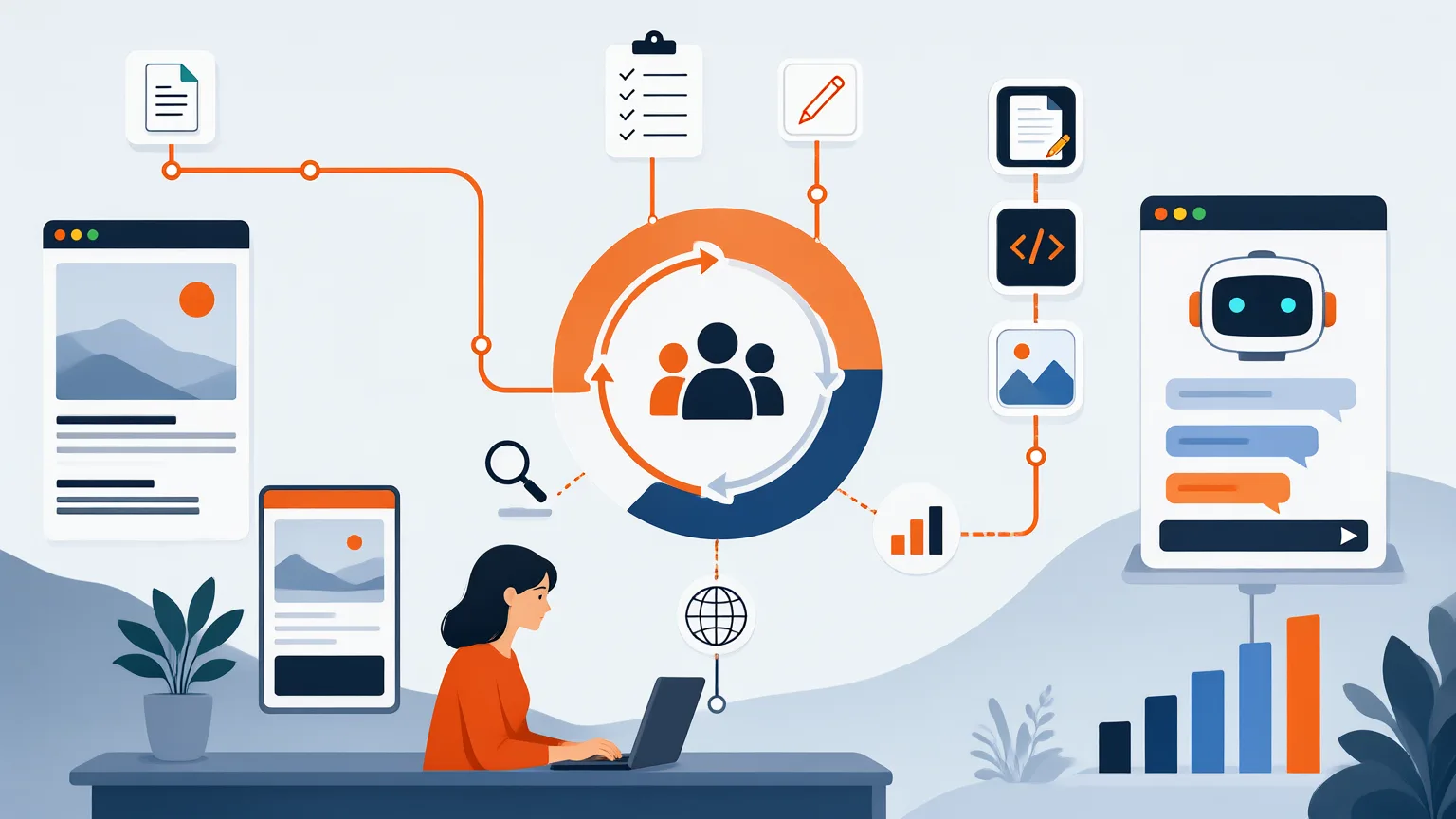
Running SEO and AI search optimization as two separate projects is how teams burn out. Treat them as one production line with two outputs.
One content system, two channels
Pick topics that show both traditional search volume and chatbot-question demand. If people search "best CRM for realtors" and also ask ChatGPT the same thing, that topic earns its place on your calendar.
Then write pages that answer directly and rank traditionally. Semrush notes that AI SEO is an extension of traditional SEO, not a replacement, so one well-built page can serve both. For a deeper walkthrough of that workflow, see AI SEO strategies for small business.
Where AI tools fit
Use AI for speed, keep humans for judgment:
- AI drafts outlines, first drafts, schema markup and repurposed social posts.
- You edit for accuracy, original experience and citations.
- You verify every claim before publishing.
What to measure monthly
Track two dashboards, not one:
- Google Search Console for rankings, impressions and clicks.
- Manual prompt checks plus brand-mention tools for AI citations.
Add a short direct answer block under your H1 or first H2 on every key page, so models can lift a clean answer.
Templates and a weekly review turn this into a repeatable system rather than a chore. That structure, plus live coaching, is what the AI Profit Boardroom is built around.
Frequently asked questions
What is the difference between AI search optimization and SEO?
SEO optimizes pages to rank in a list of blue links. AI search optimization, often called GEO or AEO, optimizes content to be cited inside AI-generated answers from ChatGPT, Perplexity, Gemini and Google AI Overviews. SEO targets rankings and clicks; AI search optimization targets mentions, citations and being the source an assistant quotes.
Which one wins in 2026?
Neither replaces the other. Classic SEO still drives the crawlable, structured foundation AI systems read, while AI search optimization captures the growing share of queries answered without a click. The winning setup is one content system doing both: technically sound pages plus clear, quotable answers that AI tools can extract and attribute.
Do I still need traditional SEO for AI search?
Yes. AI assistants pull from indexed, crawlable pages, so technical SEO, site speed, internal links and clean structure remain prerequisites.
Without them your content may never enter the retrieval layer. Treat SEO as the foundation and AI search optimization as the layer that decides whether you get cited once you are found.
How do I measure AI search visibility?
Track brand mentions and citations inside AI answers, referral traffic from AI assistants, and share of voice for your key prompts. Run your target questions through ChatGPT, Perplexity and AI Overviews monthly, log who gets cited, and compare that against your rankings and organic clicks in Search Console.
Final thoughts
SEO and AI search optimization are not rivals. Traditional SEO still earns you rankings on Google; AI search optimization earns you citations inside ChatGPT, Perplexity and Google's AI Overviews. In 2026, the businesses that win do both: clean technical foundations, genuinely useful content, and answer-first formatting that language models can quote.
Your next step is to stop treating them as separate projects. Pick one page that already ranks and rebuild it around the questions your buyers actually ask. Inside the AI Profit Boardroom, the AI SEO and content systems courses walk you through that rebuild, and the weekly live coaching calls let you pressure-test your approach with other business owners doing the same work.