Best AI Automation Tools for Small Businesses in 2026
By Julian Goldie · 28 Nov 2026
Most lists of the best AI automation tools for small businesses in 2026 fail at the same thing: they rank software instead of solving problems. You do not need a "top 40." You need to know which tool handles lead follow-up, which one writes your content, and which one quietly connects everything else without a $2,000 monthly bill.
This roundup is grouped by the job you actually need done, not by vendor size. Each section covers real pricing, the drawbacks nobody mentions in the demo, and who the tool is genuinely wrong for. At the end you get three starter stacks, matched to budget and to the task that usually pays for itself first.
If you have been paying for tools you barely open, this is the piece that tells you what to cancel, what to keep, and what to add next.
Key takeaways
- Zapier is the fastest first automation for non-technical owners; n8n is the better long-term engine once you want real AI agents.
- ChatGPT and Claude are the cheapest high-leverage tools on the list, but they only pay off once a workflow tool connects them to your business.
- Make.com wins on price for high-volume workflows, while Intercom Fin and Tidio make support automation pay for itself quickly.
- Automate the job that eats the most hours first, measure the hours saved, then reinvest in the next tool.
- A realistic starter stack costs $50-150 per month and covers content, lead follow-up and first-line support.
1. n8n: Best for Orchestrating AI Agents Across Your Whole Business
n8n is open-source workflow automation you can self-host, and its native AI agent and LLM nodes let you chain models, tools and APIs into a single agent instead of a chain of disconnected steps. One workflow can receive a lead, research the company, write the reply, update the CRM and notify you, all without a human in the middle.
It suits agency operators and technical solopreneurs who have outgrown linear Zapier workflows. If your automation now needs branches, retries and a model deciding what happens next, you are the audience.
What n8n actually automates for a small business
- Inbound lead handling: an agent reads the form, enriches the contact, drafts a reply and books a call.
- Multi-step research: pull data from an API, summarise it with a model, file the result in your database.
- Invoice and document processing: extract fields, validate them, push to accounting.
- CRM sync across systems that do not talk to each other natively.
The economics are the draw. Self-hosting removes the per-task tax that makes high-volume automation expensive elsewhere, and you keep the data on your own infrastructure.
The tradeoff is real: expect roughly 10 hours of self-teaching to get fluent, plus a server to maintain. Non-technical owners will want templates or outside help to see value quickly.
Pricing: free self-hosted (community edition, typically $10 to $20 per month for a VPS); n8n Cloud starts around $24 per month for small usage and scales with executions.
When n8n is overkill (and what to use instead)
If your automation is three steps and runs twice a day, n8n costs you more in setup time than it saves. A tool like Zapier gets that live this afternoon. Reach for n8n when workflows pass five steps, branch, or run at volume, as one 2026 review of AI automation tools for small businesses puts it.
2. Zapier: Best for Getting Your First Automation Live Today
Zapier is the widest-integration no-code automation platform on the market, and in 2026 it is no longer just a connector between apps. AI steps, AI agents and chatbots are built into the product, so you can draft a reply, classify a lead or summarise a form submission inside the same workflow that moves your data.
Who it suits: small business owners with zero technical background who want a lead-capture-to-CRM-to-email workflow running within an hour. One ranking of AI automation tools for small business calls Zapier the best place to start, noting the free plan covers 100 tasks a month and that most owners have a first workflow live in an afternoon (AI Tool Pipelines).
Strengths
- 7,000+ app integrations, the broadest coverage of any tool in this roundup
- Best-in-class templates: pick your trigger and action, fill in the blanks, done
- AI features that draft and route without code
- A genuinely usable free tier, not a trial
Drawbacks
- Costs scale fast with task volume. The bill arrives around month three, when usage stabilises.
- Complex multi-branch logic gets messy fast.
- Heavy users often migrate to Make or n8n later, once a stack of Zaps starts costing more than it should.
Price: free tier; paid plans typically start around $20-30/month billed annually, rising with task volume.
The three Zapier automations most small businesses should build first
- Lead capture to CRM to welcome email. Form submission triggers a CRM record, then a personalised reply. This is the one-hour build.
- New customer question to drafted answer. An AI step reads the message, drafts a reply in your tone, and routes it for approval.
- Won deal to onboarding sequence. Status change triggers your invoice, welcome pack and kickoff task in one pass.
Build one, watch it run for a week, then add the next. If your first workflow is content or search-driven rather than sales-driven, our AI SEO strategies for small business cover where automation fits in that pipeline.
3. Make.com: Best Value for Visual, High-Volume Workflows
Make.com is a visual scenario builder that sits between Zapier's simplicity and n8n's power. You drag modules onto a canvas, connect them with lines, and watch data flow through each step. It includes AI modules and agent features, so you can drop a model call into the middle of a scenario without leaving the builder.
It suits businesses running hundreds or thousands of operations a month that want more logic than Zapier allows but do not want to self-host anything.
Strengths
- Operations-based pricing is far cheaper at volume. Make's entry paid plan is commonly cited at around $9 per month for 10,000 credits, which is where the value case gets obvious.
- The visual canvas makes complex branching readable. Routers, filters and parallel paths are visible at a glance instead of buried in settings.
- Error handling is strong: you can attach error handlers to individual modules, set retries, and route failures to a fallback path.
Drawbacks
- The canvas can overwhelm beginners. A 20-module scenario is powerful and also intimidating.
- Debugging long scenarios takes patience, especially when data arrives in an unexpected shape.
- Documentation is thinner than Zapier's, so you will lean on community answers more often.
| Factor | Make.com | Zapier | n8n |
|---|---|---|---|
| Pricing model | Operations/credits | Tasks | Executions or self-host |
| Entry paid price | Around $9-10/month | Higher per task | Free self-hosted, cloud from $20/month |
| Visual complexity | High, canvas-based | Low, linear | High, node-based |
| Best volume fit | Hundreds to thousands | Under 1,000 runs/month | High volume with technical help |
One practical pattern: if your scenarios feed content or SEO work, the workflow that publishes and tracks pages matters as much as the automation itself. Our guide to AI SEO strategies for small business covers that side.
4. ChatGPT and Claude: Best AI Brains for Writing, Analysis and Customer Replies
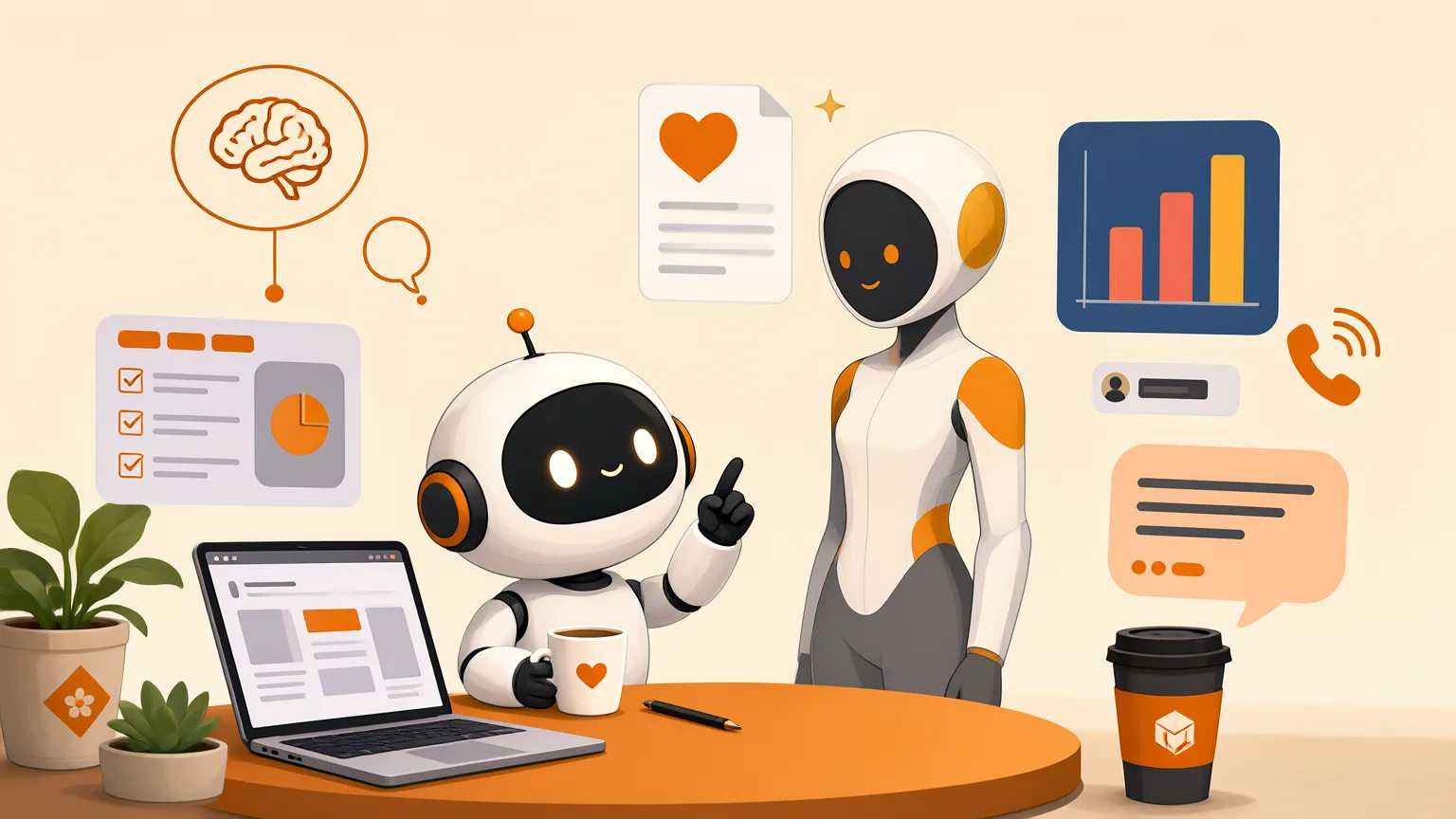
ChatGPT and Claude are general-purpose AI assistants. They handle the thinking layer of your business: drafting content, summarising calls, analysing spreadsheets and answering customer questions. They are not workflow tools, and they will not connect to your CRM on their own.
Every small business can use at least one of them. At roughly $20/month per user, they are the cheapest high-leverage tools on this list, and usually the first to pay for themselves, one recovered hour a week covers the subscription.
Strengths
- ChatGPT leads on breadth: plugins, image and voice handling, and the widest range of integrations.
- Claude leads on long-document analysis, tone control and careful writing. It is the stronger pick for contracts, reports and anything where the wording matters.
Drawbacks: both hallucinate when they lack context or a tight prompt, and neither automates anything by itself. They need a workflow tool around them to fire on a trigger, a new lead, a new email, a finished call.
Price: free tiers exist. Paid plans are typically around $20/month per user, with team and API pricing above that.
ChatGPT vs Claude: which to pick for a small business
| If your work is mostly… | Start with |
|---|---|
| Marketing copy, social posts, brainstorming, voice | ChatGPT |
| Long reports, proposals, tone-sensitive replies | Claude |
If you can only justify one, pick the one that matches your highest-volume writing task and revisit in three months.
How to connect your AI brain to your automation tool
The assistant is the brain; n8n, Zapier or Make is the hands. A simple pattern:
- A trigger fires (form submission, new email, closed call).
- The workflow sends the content plus your business context to the AI.
- The AI returns a draft or answer.
- The workflow posts it to your inbox, CRM or help desk for approval.
In AI Profit Insider, this pattern appears as a ready-to-use AI agent setup: you take the template, drop in your own prompts and connect it to your existing tools, and the agent drafts replies or content without you starting from a blank page each time.
5. HubSpot Breeze, Intercom Fin and Tidio: Best for Customer Support and Sales Follow-Up
These are AI agents that answer customer questions, qualify leads and book meetings without a human in the loop. They suit service businesses drowning in repetitive enquiries, and e-commerce stores where chat pays for itself within a few sales.
- Intercom Fin resolves a meaningful share of tickets automatically. You pay per resolved conversation, around $0.99, so costs track outcomes rather than seats.
- Tidio is cheap and fast to deploy, with a free tier and paid plans from roughly $29/month. Good first chat agent for a small store.
- HubSpot Breeze ties AI into a full CRM, so replies, lead scoring and follow-up sequences live in one place.
The drawbacks are consistent across all three. Answer quality depends entirely on your knowledge base: thin help docs produce thin answers.
Setup takes real work, usually a week of loading FAQs, policies and product data before the agent is trustworthy. And costs rise with resolution volume, so a busy month can surprise you.
Intercom Fin and HubSpot Breeze are priced per resolution or seat and get expensive at scale. Tidio stays cheaper longer.
If you want a worked example, AI Profit Insider shows how to load your FAQs and policies into an agent setup, then hand it your inbound chat so it answers, qualifies and books.
6. The Starter Stacks: Which Combination Actually Pays Off First
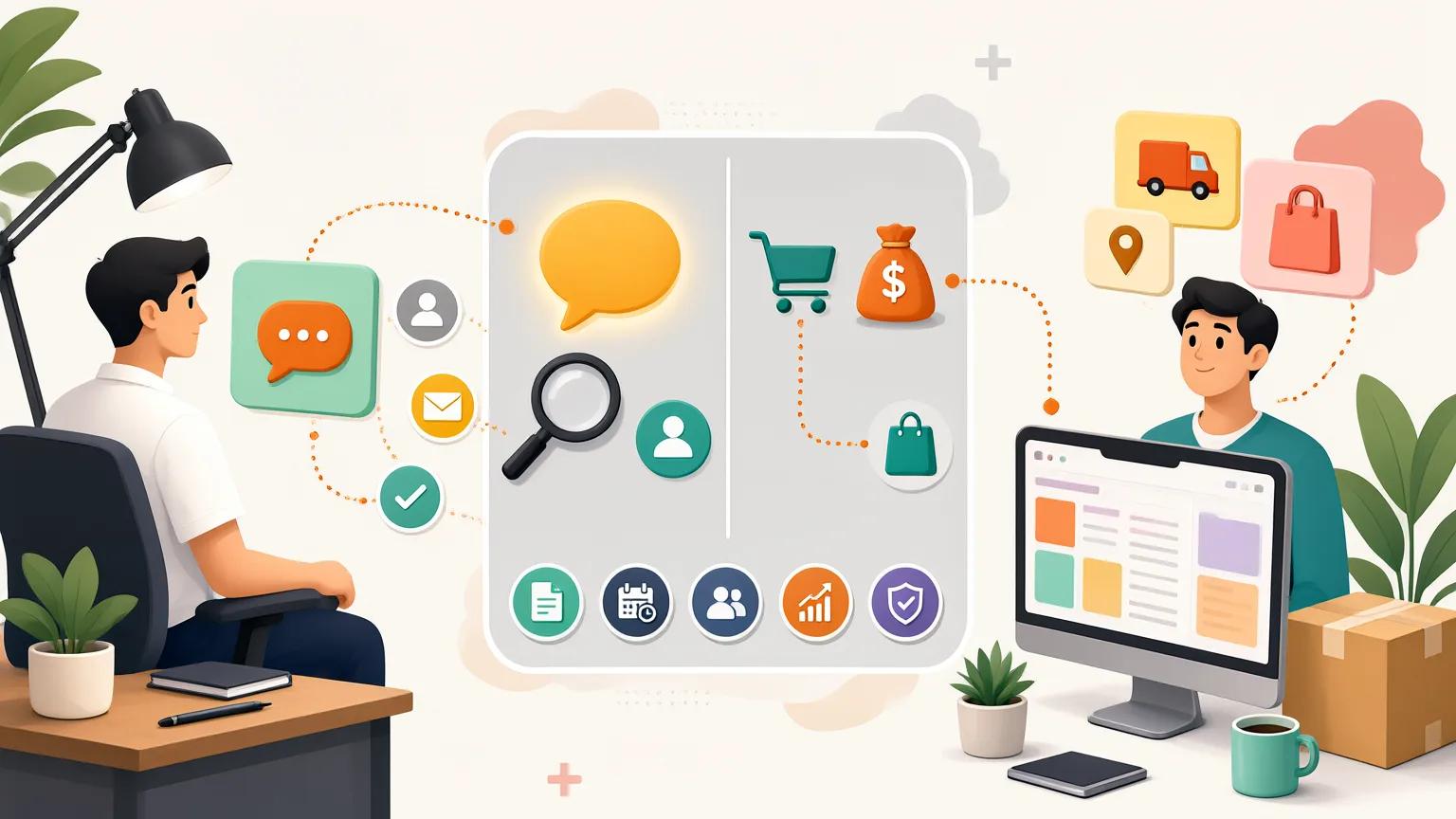
Buying tools one at a time is how small businesses end up with six subscriptions and no working system. Stacks that map to a business model pay back faster, because each tool feeds the next one. These three cover most small operations.
Stack 1: the solo service business
ChatGPT or Claude, Zapier, and Tidio. Around $20 for the AI assistant, Zapier's free plan gives 100 tasks a month before you upgrade, and Tidio's entry tier handles live chat and a first-line bot. Total: under $70/month.
- The assistant writes proposals, emails and service pages.
- Zapier routes form fills and enquiries into your inbox or CRM.
- Tidio answers the repeat questions before you see them.
Stack 2: the e-commerce store
Make.com, Tidio, and QuickBooks with Intuit Assist. Make starts at $9/month for 10,000 credits, which suits order and fulfilment workflows. Tidio covers pre-sale questions and order-status replies. Intuit Assist handles categorisation and the year-end clean-up that eats a weekend.
Stack 3: the agency or technical operator
n8n, Claude, and Airtable. This is the build-it-once stack: custom agents that answer leads, write content and run internal tasks. n8n cloud starts at $20/month, and self-hosting runs $10-20 for a VPS, though plan on roughly 10 hours of learning before you are fluent, per Veteran Vectors.
The rule that matters
Automate the job that eats the most hours first. Measure the hours saved, then reinvest those savings in the next tool. One source puts AI adoption in at least one business function at 88%, with scaling adoption at just 29% for smaller companies, so the advantage sits in finishing the build rather than starting it.
If you would rather copy a working system than assemble one, step-by-step agent setups, templates and weekly coaching are what the AI Profit Boardroom exists for.
Frequently asked questions
What are the best AI automation tools for small businesses in 2026?
The strongest picks split by job: ChatGPT and Claude for writing and analysis, Zapier and Make for connecting apps, HubSpot and Intercom for sales and support agents, and n8n for technical teams. Most small businesses get further by combining two or three of these than by buying one all-in-one platform. Choose based on the task you want automated first.
How much should a small business budget for AI automation tools in 2026?
Expect roughly 20 to 100 dollars per user per month for mainstream tools, with entry tiers near 20 to 30 dollars. Automation platforms like Zapier and Make price by task volume, so costs scale with usage rather than seats. Start with one paid tool tied to a measurable task, then add spend only when the hours saved justify it.
Which AI automation tool is easiest for a small business with no technical staff?
Zapier is the simplest starting point because it connects thousands of apps through a visual builder and plain-language setup. Make offers more logic at a slightly steeper learning curve. If you want an agent answering leads or writing content without wiring anything yourself, a guided setup inside a community like the AI Profit Boardroom removes most of the technical work.
Can AI automation tools replace hiring for a small business?
They replace tasks, not whole roles. AI agents can answer inbound leads, draft content, qualify enquiries and run repetitive admin, which often removes the need for a part-time hire.
Judgment, relationships and final approval still sit with you. Treat automation as capacity you add before headcount, not as a substitute for every role.
Final thoughts
The best AI automation tools for small businesses in 2026 are the ones you actually use: pick a single bottleneck, whether that is lead follow-up, content production or reporting, and automate it before adding anything else. Most owners get further with one working workflow than with five half-configured subscriptions. Your next step is to start with a proven setup rather than a blank page. Inside the AI Profit Boardroom you get ready-to-use AI agent setups, step-by-step automation workflows and weekly live coaching calls, so you can launch your first agent this week and expand from there.